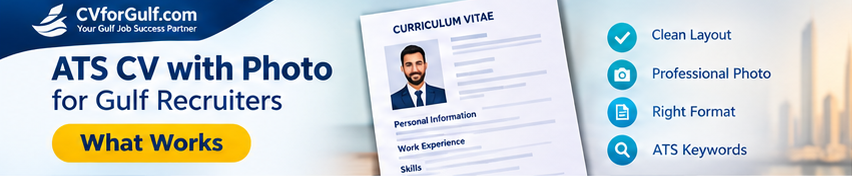
Searches for ats cv with photo and ats cv photo come from a real tension: Gulf employers often like photos, while applicant tracking systems like clean text. You can satisfy both with careful layout.
What ATS systems actually need
Parsers look for standard section headings and extract text. They struggle when the whole CV is a single flat image or when text sits in complex nested tables. They do not “need” a photo—but a photo does not automatically fail ATS if the text remains selectable and ordered.
Gulf photo expectations
In UAE, Saudi and Qatar private-sector hiring, a professional photo remains common. The goal is identification and presentation, not decoration. Keep the image small, high-quality and placed in the header—not scattered through every section.
Layout patterns that work
- Header row with name, title, contact text, optional photo
- Normal headings: Summary, Experience, Education, Skills
- Bullets as real text lists
- Limited columns; if you use two columns, keep critical experience in a clear primary flow
Try ATS Classic Gulf CV or other simple options in templates.
File type
PDF from a text-based template is the usual path. A scanned photo of a printed CV is the wrong kind of “photo CV.” Build digitally in the CV maker.
Keywords without stuffing
ATS may score keyword presence. Put real skills in context. Copying the entire job description into the summary hurts human readers and can look manipulative.
Testing
After login, run ATS check on a saved CV. Read human-focused tips in Is your CV ATS-friendly?
When photo should be removed
Follow the job ad. Some international employers or specific public processes prefer no photo. Keep a photo-off version ready.
Photo technical tips for parsers and humans
Crop tightly, use adequate resolution, and keep file size reasonable inside the template. Do not place critical contact text only inside the photo graphic. Contact details must remain real text in the HTML or PDF text layer so both humans and systems can read them.
Two-column designs
Two-column CVs can look modern and still pass basic ATS if the experience column is linear and headings are standard. Problems appear when skills are icon-only or when dates are separated from employers in unpredictable order. Preview in the builder and, if unsure, keep a single-column ATS variant for portal uploads.
Gulf recruiters who read by hand
Not every Gulf hire goes through heavy software. Agency recruiters and SME owners often open the PDF and decide visually. That is why photo quality and spacing still matter even when you optimise for ATS. Balance both audiences: clean text first, polished presentation second.
Icon skills and graphics
Skill bars and icon-only tool lists often fail parsing and add little for humans. Write “AutoCAD, Revit” in text. Save visual flair for portfolios when the industry expects a portfolio, not for the CV spine.
Headers and footers
Repeating headers with your name on each page help human readers in long senior CVs. Keep them text-based. Avoid putting the only copy of your email exclusively in a footer image.
Multiple PDF exports
Keep an ATS-leaning PDF for portals and a slightly more designed PDF for direct email to small firms if you wish—but keep facts identical. Dual versions are fine; dual stories are not.
Practical next steps this week
Block ninety minutes. Gather dates, employer names and two numbers per role. Open the free builder on CVforGulf, choose a simple template, and produce one PDF. Send it to a trusted colleague for a ten-minute review. Apply to one real vacancy with that version. Iterate from response, not from endless redesign.
Internal links worth saving: CV maker, templates, Gulf format, ATS check, writing services, and pricing if you plan to upgrade.
Detailed example: turning a weak bullet into a Gulf-ready bullet
Weak: “Responsible for managing daily operations.” Stronger: “Coordinated daily operations for a 12-person team across two shifts, cutting overtime hours by 15% over six months while meeting service targets.” The second version gives scale, action and result. Gulf recruiters can ask follow-up questions; the first version invites silence.
Apply that pattern to each role on your CV. If you cannot find a number, use scope: systems used, regions covered, document types owned, stakeholders supported. Scope is still evidence.
How this topic connects to the rest of CVforGulf
Topical authority comes from interlinked coverage, not from one isolated post. After reading this article, use the matching tool pages so Google and readers see a complete cluster: format guides, maker, templates, ATS, and expert help. That is deliberate site architecture for Gulf and Pakistan job search—not random blogging.
Suggested path for most readers: finish one PDF in the builder, read the country format page that matches your target, run ATS check if you apply through large portals, then decide whether expert writing is necessary. Do not buy services before you have attempted one honest draft; do not refuse help forever if drafts stall.
Mistakes we still see every week
- Different phone numbers on CV and LinkedIn
- Employment dates that overlap by accident
- Templates with skill bars and no real text skills
- Summaries that never name a job title
- PDFs exported from scans of printed paper
- Copying job-ad paragraphs into the summary unchanged
Fixing those six issues improves response rates more than changing theme colours for the fifth time.
For recruiters and HR readers
If you hire for Gulf operations, clear candidate CVs save screening time. Point applicants to structured formats and honest free tools rather than accepting five-page narratives. Consistent section headings also help your own ATS configuration. CVforGulf exists primarily for candidates, but cleaner inputs help employers too.
Employer-side diversity policies
Some multinational employers minimise photos to reduce bias. Others in regional private sector still expect them. The vacancy and company culture decide. Maintain both a photo and no-photo export when you apply widely.
Search intent and why this page exists
People who land here from Google usually need a concrete outcome in the same day: a file to upload, a rule to follow, or a decision between DIY and paid help. This article is written for that intent. It avoids theory that does not change your PDF and focuses on actions that affect UAE, Saudi, Qatar and Pakistan applications.
If you only remember three actions, remember these: use reverse-chronological structure, prove results in bullets, and export a clean PDF named with your real name. Everything else—photo, visa line, template choice—supports those three.
Keeping claims interview-safe
Every strong line on a Gulf CV should survive a five-minute probe. If you write “managed procurement,” be ready to name categories, vendors and approval limits. If you cannot, rewrite the bullet to the level you can defend. Interview-safe writing is not modest writing; it is accurate writing.
Conclusion
An ATS CV with photo is possible for Gulf applications when text stays structured and the image stays secondary. Use a simple Gulf template, export PDF, and test before you apply at scale.
Frequently Asked Questions
Can an ATS CV include a photo?
Yes, if the layout keeps real text headings and a simple reading order. Avoid embedding all content inside images.
Do Gulf recruiters want photos on ATS CVs?
Many GCC private-sector employers still expect a professional photo. Large ATS systems mainly need clean text; a small photo in the header is usually fine.
How do I test my ATS CV?
Use simple templates, save a copy, and run CVforGulf’s ATS check tool on a saved CV after login.
Ready to improve your application documents?
Start with a free CV or LinkedIn draft on CVforGulf — built for Gulf and Pakistan hiring.
Create free CV →