If you are applying for roles in the UAE, Saudi Arabia, Qatar or from Pakistan to the Gulf, the layout of your CV matters almost as much as the content. Recruiters scan fast. Many portals parse your file before a human opens it. Choosing between a single-column CV and a two-column CV is not about fashion—it is about where the application will be read first.
This guide explains the difference in plain language, what Gulf hiring teams tend to expect, and how to pick a layout without guessing.
What “single-column” and “two-column” actually mean
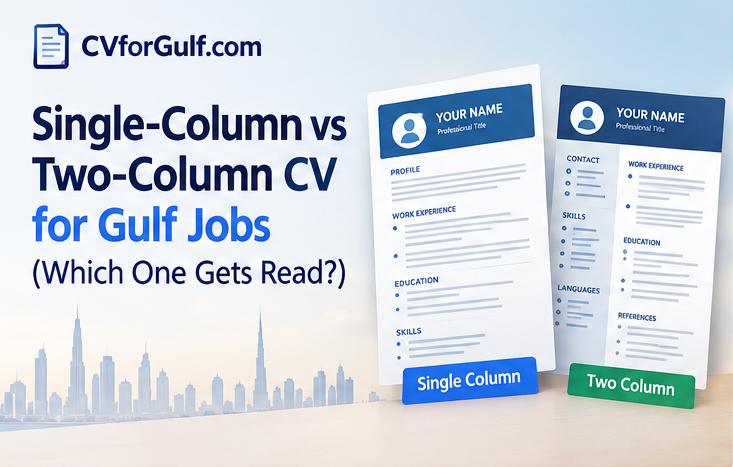
A single-column CV stacks everything in one vertical flow: name and title, then summary, experience, education, skills. Contact details sit in the header or just under it. There is no sidebar.
A two-column CV splits the page. One side often holds photo, contact, skills and languages; the other holds summary and work history. Designs like a soft sidebar or a dark “prime” sidebar fall into this group.
Both can look professional. They fail for different reasons when the file is uploaded to a rigid system or emailed as a messy export.
How Gulf applications are actually screened
In the GCC, your CV may pass through:
- Job portals and company career sites (often ATS-style parsing)
- Recruitment agencies that forward PDFs to clients
- Hiring managers who open the file on a phone or laptop
Nationality, visa or residency status, and a clear target title still matter in many UAE and Saudi processes. A professional photo is common in a large share of Gulf applications—unlike many Western markets—though some employers prefer text only. Your layout should make those signals easy to find without hiding your experience.
When a single-column CV is the safer choice
Prefer a single-column, ATS-friendly CV when:
- You apply through a large portal or government-linked system
- The form only accepts one file and has caused problems before
- You are early in your search and want one reliable master file
- Your priority is clean parsing of job titles, dates and employer names
A layout such as Gulf Classic on CVforGulf is built for this path: one column, standard section order, optional lines for nationality, visa and notice period without a heavy graphic frame.
When a two-column CV helps you
A two-column CV can work better when:
- A recruiter or hiring manager will open the PDF themselves
- You need a strong first screen (photo, skills, contact in view at once)
- You are mid or senior level and the story benefits from visual hierarchy
- You are emailing the CV or sharing it after a referral
Templates such as Peach Two-Column, Executive Header or Prime Sidebar suit human review. They still use real text—not a flat image—so content stays selectable. For the strictest uploads, keep a single-column twin of the same content.
Photo CVs vs “picture CVs” (important distinction)
A photo on a structured CV is normal in much of the Gulf. A picture CV (whole page designed as artwork, text inside images) is what many ATS tools skip. If robots cannot select your job titles, you lose ranking before a person decides.
Use a clean template with an optional photo slot. Avoid exporting from pure design tools without checking that text remains text in the PDF.
Practical rule of thumb for UAE, Saudi and Pakistan
- Portal-first applications → start with single-column (Gulf Classic style).
- Email, agency, LinkedIn follow-up → two-column or executive header is fine.
- Always match the job title language in the header and summary.
- Always keep dates consistent and bullets focused on results, not only duties.
- If unsure, keep two PDFs of the same facts—one single-column, one visual—and use the right file for the channel.
Content still beats layout
Layout only presents the story. Gulf shortlists still favour clear scope (team size, sites, tools, revenue, projects) and honest eligibility. A beautiful empty sidebar does not fix a vague summary. Write the content first, then choose the template.
On CVforGulf you can draft once in the free CV builder, switch layouts (including Gulf Classic and Prime Sidebar), and export PDF. Logged-in users can save versions and use ATS-style checks within plan limits.
Quick comparison
| Factor | Single-column | Two-column |
|---|---|---|
| ATS / strict portals | Usually safer | Higher risk on some systems |
| Human email review | Clear, sometimes plain | Often stronger first impression |
| Photo + skills visibility | Needs careful header placement | Natural in a sidebar |
| Best default for volume applications | Yes | Use selectively |
Conclusion
For Gulf jobs, do not argue “single vs two-column” in the abstract. Match the channel: single-column for rigid systems, structured two-column for people. Keep text real, eligibility clear, and results visible. Then apply with the file that fits the path—not only the design you like most on screen.
Start with a single-column Gulf CV → · Browse all CV templates →
Ready to improve your application documents?
Start with a free CV or LinkedIn draft on CVforGulf — built for Gulf and Pakistan hiring.
Create free CV →