Update 25 November 2026: Renamed the first section, replaced a repeated link with relevant country CV format guides, corrected the wage protection wording to cover Saudi Arabia, added author details and one FAQ.
Key takeaways
- For the same kind of role, Gulf cash salaries are several times higher than Pakistan salaries, but the size of the gap depends on role, seniority and employer.
- Gulf salaries are generally not taxed, while Pakistan taxes salary above PKR 600,000 a year, so low earners there pay little or none.
- Housing, transport and food can add real value on many Gulf labour and technician roles, so ask what is included in writing.
- Compare an offer against postings for your exact role and city, not a national average.
In this guide
"You will earn more abroad" is easy to say and hard to check. This guide puts published salary figures from Pakistan and the Gulf side by side, then covers what a cash-to-cash comparison leaves out.
1. Pakistan vs Gulf pay at a glance
Monthly gross figures, converted to approximate US dollars. Ranges are not matched for seniority, so read each row as a rough guide.
| Role | Pakistan (monthly, ~USD) | UAE (monthly, ~USD) | Saudi Arabia (monthly, ~USD) |
|---|---|---|---|
| Driver | ~$107 (PKR 30,000, reported average) | ~$675 (AED 2,479, average) | ~$320–$775 (SAR 1,200–2,900, typical range) |
| Civil / project engineer | No reliable figure found; varies widely by seniority | ~$5,450–$12,250 (AED 20,000–45,000) | ~$6,650–$13,300 (SAR 25,000–50,000, project management roles) |
| IT / software | ~$265–$1,610 (PKR 73,646–446,989; 80% of respondents, Paylab Pakistan) | ~$6,800–$13,600 (AED 25,000–50,000) | Strong Vision 2030-linked demand; check current postings |
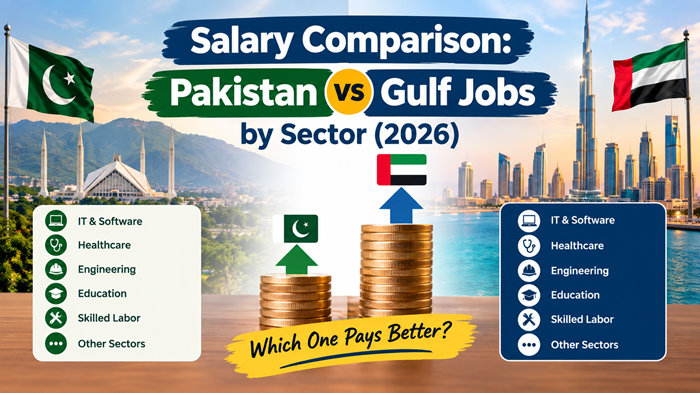
The pattern holds even with wide ranges: for the same kind of role, Gulf cash salaries are several times higher than Pakistan salaries. The size of the gap depends on role, seniority and employer, so there is no single multiple. For drivers, the averages above are about six times apart. For experienced IT and engineering staff the gap can be larger, because Gulf pay rises steeply with seniority.
We left out a technician row on purpose. We could not find like-for-like technician figures for both countries, and comparing different jobs would be misleading.
2. What the raw numbers don't show
A cash-to-cash comparison can understate the real gap, for three reasons.
- Tax. Salaried workers in Pakistan pay income tax above PKR 600,000 a year (about PKR 50,000 a month) for FY2026-27, with a 1% rate on the first band above that. Low earners pay little or nothing, while higher earners pay more as pay rises. Gulf salaries are generally not taxed.
- Housing, transport and food. Many Gulf driver, construction and technician roles include free or subsidised accommodation, transport and sometimes meals. These do not appear in the quoted salary, but they have real monthly value. The amount varies a lot by employer, so ask for details in writing.
- Savings and remittances. What matters is what is left after living costs, because many workers send money home.
On the other side, Gulf cities have their own cost of living for anything your employer does not cover. "Tax-free" does not mean "cost-free". Count both sides, not just the headline number.
3. A closer look, sector by sector
Drivers and technicians
This is where the gap is easiest to see. Pakistan driver pay is often reported around PKR 30,000 a month. That is below the PKR 40,700 federal minimum wage announced in the 2026-27 budget, so figures at this level may reflect informal pay and vary by province. Gulf driver roles, even at the lower end, are meaningfully higher: a BEOE-listed Saudi driver posting we found offered SAR 1,200–1,500 a month, before any accommodation and food the employer provides. To present this experience on paper, see our Pakistan CV format guide and the CV builder.
Engineering
Saudi Arabia's giga-projects, including NEOM, Red Sea Global and Qiddiya, are reported to drive premium packages for engineering and project management roles, sometimes including housing and education allowances at senior levels. The UAE remains strong and competitive, particularly in construction and infrastructure in Dubai and Abu Dhabi. For CV format differences, see the Saudi CV format and UAE CV format pages.
IT and technology
Specialisation drives the biggest gains. AI, cloud and cybersecurity roles are reported to be seeing the fastest salary growth in the Gulf in 2026, with senior software engineers in the UAE reported at AED 32,000–50,000 a month. Generalist roles see smaller, though still substantial, premiums over Pakistan.
Healthcare
Demand is strong across all three markets. Licensing (for example DHA or MOH processing in the UAE) can take weeks and is often the biggest bottleneck, so start early and check current timelines with the licensing body.
Hospitality and tourism
The UAE's hospitality sector is reported to be rebounding, with continued demand for hotel-operations professionals. Pre-opening hotel experience or multi-property management is worth calling out clearly on your CV, not leaving buried in a general job description.
4. What to check before accepting an offer
- Is accommodation, transport and/or food included, or is the quoted salary the entire package?
- Is salary paid through a wage protection system? The UAE, Saudi Arabia and Qatar each run one for private-sector employers, so ask how your pay will be transferred.
- What is the end-of-service gratuity structure, and how is it calculated?
- Is the figure gross or net, and are there any other deductions?
- How does the number compare to recent postings for the same role and city, not just a national average?
5. Using this data when you negotiate
A number from a general salary guide is a starting point for a conversation, not a figure to quote as your own worth. Narrow it: find postings for your exact role, seniority and city, since the spread within one role can be as wide as the gap between countries. A junior driver and a senior driver with GCC experience can see a large difference in the same country and job title, driven by years of relevant experience and any specialist certification.
Ask what part of the offer is guaranteed base pay and what part is variable allowance. Allowances tied to performance or site conditions are less stable than a fixed salary. A slightly lower guaranteed base with clearly documented fixed allowances is often a more reliable package than a higher headline number built on variable components.
Quick checklist
- Compared the offer with a role-specific benchmark, not a national average
- Confirmed what is included beyond cash salary (housing, transport, food)
- Checked the employer pays through WPS or an equivalent protected system
- Understood the end-of-service gratuity terms
- Counted realistic cost of living for anything the employer does not cover
- Separated guaranteed base pay from variable or performance-linked allowances
A strong offer starts with a strong CV. None of the above matters if you are not getting interviews, so see our ATS format guide and the Gulf CV format guide to make sure your CV reaches a recruiter before you reach the salary conversation.
Frequently asked questions
How much more do Gulf jobs pay compared to Pakistan?
It depends on the role. Using published averages, a driver in the UAE earns roughly six times the reported Pakistan figure, and experienced engineers and IT staff in the Gulf can earn many times more than typical Pakistan pay. The gap is wide but not one fixed multiple, so compare postings for your own role, seniority and city.
Do Gulf salaries get taxed?
The UAE, Saudi Arabia and Qatar do not charge personal income tax on salary. Pakistan does above PKR 600,000 a year (FY2026-27), starting at a 1% rate, so lower earners there pay little or none. Check the current rules before you decide, as tax laws change.
Are accommodation and transport usually included in Gulf salary offers?
Often for driver, construction and technician roles, less often for office roles, where an allowance may be paid instead. It varies by employer, so ask for exactly what is included and get it written in the offer or contract.
Is the average salary figure a good number to compare against?
Only as a starting point. Averages mix junior and senior staff and different employers. Look for postings that match your exact role, experience and city, and use the average only to check that an offer is in a sensible range.
Which Gulf country pays the most?
There is no single answer. The UAE and Saudi Arabia are both competitive, and Saudi giga-projects pay premium packages for some engineering and project roles. Qatar also hires heavily in some sectors. Compare the full package, not only the salary, because housing, schooling and cost of living differ by city.
What should I check in a Gulf job offer before accepting?
Check what is included beyond cash salary (housing, transport, food), how pay is transferred, how end-of-service gratuity is calculated, whether the figure is gross or net, and how it compares with postings for your exact role and city. Get the terms in writing.
Sources & further reading
- Paylab Pakistan: Software engineer salary survey (80% range PKR 73,646–446,989; 50 respondents)
- Business Recorder: Tax-free income threshold unchanged for FY2026-27
- Daily Pakistan: Minimum wage raised to Rs40,700 in Budget 2026-27 (12 Jun 2026)
- Pakistan Observer: Currency exchange rates in Pakistan today, 27 October 2026
- Paylab.com: Pakistan and Saudi Arabia salary survey data (2026)
- Indeed: Driver salaries in Pakistan and UAE (2026)
- Gulf Workforce: UAE Salary Guide by Industry 2026
- Token Talent: Average Salary in UAE by Profession 2026
- Expertise Recruitment: Comparison of Expat Salaries in the Middle East 2026
- BEOE: Foreign jobs listings
- ATS format guide
- Pakistan CV format
- Gulf CV format guide
Rules and requirements change. Check the employer or the official source before you act. This guide is general information, not legal or immigration advice.
Get your CV Gulf-ready
Build a CV formatted for how Gulf recruiters screen. Free to start.
Create my free CV